

Reusable Apparel E-Commerce Mailers Market Growth 2026–2036: Global Market to Reach USD 5.2 Bn by 2036 at 12.51% CAGR
Reusable Apparel E-Commerce Mailers Market
South Korea’s closed-loop delivery system drives 10.5% CAGR, boosting eco-returns, and seamless mailer collection in high-density urban e-commerce networks.
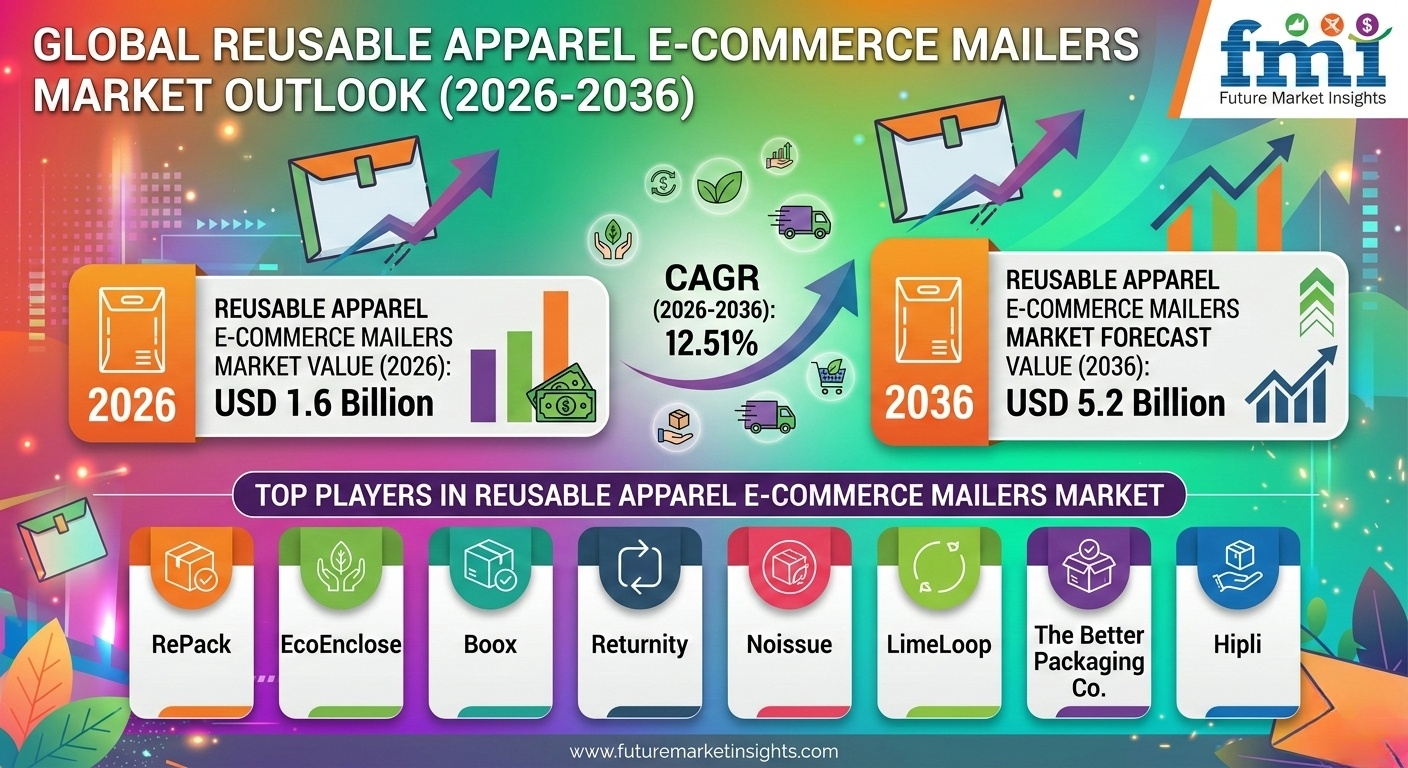
NEWARK, DE, UNITED STATES, March 18, 2026 /EINPresswire.com/ -- The global reusable apparel e-commerce mailers market is entering a pivotal growth phase, driven by tightening environmental regulations and the urgent need for cost-efficient, circular fulfillment systems. Valued at USD 1.4 billion in 2025, the market is projected to reach USD 1.6 billion in 2026, expanding at a CAGR of 12.51% and ultimately unlocking a USD 5.2 billion opportunity by 2036, according to a comprehensive analysis by Future Market Insights (FMI).
This growth trajectory reflects a fundamental shift in how apparel brands approach packaging. What was once treated as a disposable operational expense is now being re-engineered into a reusable, trackable, and revenue-sensitive logistics asset.
Regulatory Pressure and Margin Erosion Drive Adoption
The accelerating adoption of reusable mailers is closely tied to global policy frameworks such as the EU Packaging and Packaging Waste Regulation (PPWR) and extended producer responsibility (EPR) mandates. These regulations are forcing apparel retailers—especially fast fashion giants—to abandon single-use poly-mailers or face escalating financial penalties.
Discover Growth Opportunities in the Market – Get Your Sample Report Now
https://www.futuremarketinsights.com/reports/sample/rep-gb-32271
Key growth drivers include:
• Rising EPR taxes increasing per-unit packaging costs
• Global plastic bans reshaping procurement strategies
• Consumer backlash against excessive packaging waste
• Margin pressure in fast fashion, where packaging inefficiencies can erase profitability
For high-volume apparel retailers, the economic equation is increasingly clear: failure to adopt reusable packaging models risks turning low-margin transactions into loss-making operations.
Reverse Logistics Emerges as the Critical Bottleneck
While durable, multi-trip mailers offer clear environmental and cost advantages, the market’s true inflection point lies in reverse logistics efficiency. Industry data indicates that consumer return behavior—not material cost—is the primary constraint on scalability.
Emerging solutions addressing this challenge include:
• QR code and app-based return systems (38.6% market share in 2026)
• Deposit-based incentives to encourage consumer participation
• Retail drop-off networks reducing return friction
• Carrier API integrations automating return postage
Without seamless return mechanisms, reusable mailers risk becoming high-cost, single-use assets—undermining the entire circular model.
Material and Design Innovation Reshape Product Strategy
Market leaders are investing heavily in materials and structural design to maximize lifecycle performance and reduce per-trip costs.
• Recycled plastics (rPET/rPE) dominate with a 58.4% share, offering durability across 20–50 transit cycles
• Flexible pouches lead with 44.2% share, driven by their ability to collapse flat and minimize return shipping costs
• Integrated tracking technologies enable lifecycle monitoring and asset optimization
This shift reflects a growing emphasis on total cost of ownership, rather than upfront material cost, as the key procurement metric.
Europe Leads, Asia-Pacific Scales, North America Optimizes
Regional dynamics reveal a multi-speed global transition shaped by regulation, infrastructure, and consumer behavior:
• Europe leads adoption, with Germany (16.8% CAGR), UK (15.2%), and France (14.5%) driven by strict regulatory enforcement and strong deposit-return culture
• North America grows steadily (U.S. at 12.4% CAGR), supported by subscription-based apparel models and carrier integration
• Asia-Pacific scales rapidly, led by China (11.8%), with high-density logistics networks and app-based ecosystems enabling efficient circular systems
These regional variations highlight the importance of localized reverse logistics strategies in achieving profitability.
Competitive Landscape: From Packaging Suppliers to Platform Providers
The competitive structure of the reusable mailers market is evolving from product-based competition to integrated platform ecosystems. Leading players are differentiating through software-enabled logistics and carrier partnerships rather than material innovation alone.
Key companies include:
RePack, EcoEnclose, Boox, Returnity, Noissue, LimeLoop, The Better Packaging Co., Hipli
Market leaders are increasingly offering:
• Packaging-as-a-service (PaaS) models
• Integrated tracking and analytics platforms
• Pre-negotiated carrier return networks
• Lifecycle and carbon footprint reporting tools
This evolution is raising barriers to entry, as new entrants must simultaneously build physical infrastructure and digital ecosystems.
Analyst Perspective: Circular Packaging Demands Behavioral Design
According to FMI analysis, the long-term success of reusable mailers hinges on aligning logistics systems with consumer behavior.
“Reusable packaging fails not because of cost, but because of friction,” notes an FMI analyst. “The brands that win will be those that embed return behavior seamlessly into everyday consumer journeys—making it effortless, incentivized, and immediate.”
Future Outlook: From Sustainability Initiative to Operational Mandate
Looking ahead, the reusable apparel e-commerce mailers market is expected to transition from early adoption to mainstream deployment, particularly as:
• Postal carriers standardize return processing costs
• Governments tighten reuse targets and enforcement
• Brands integrate circularity into core supply chain KPIs
By 2030, reusable mailers are likely to become a baseline requirement rather than a competitive differentiator in major apparel markets.
For decision-makers, the message is clear: investing in circular packaging is no longer optional—it is a strategic necessity tied directly to profitability, compliance, and brand equity.
Why FMI: https://www.futuremarketinsights.com/why-fmi
Explore More Research Reports by FMI
Travel-Ready Sanitizer and Disinfectant Packaging Market - https://www.futuremarketinsights.com/reports/travel-ready-sanitizer-and-disinfectant-packaging-market
Cosmetic Glass Ampoule Market - https://www.futuremarketinsights.com/reports/cosmetic-glass-ampoule-market
Peggable Packaging for IT Accessories Market - https://www.futuremarketinsights.com/reports/peggable-packaging-for-it-accessories-market
Transit Packaging Solutions for IT Hardware Accessories Market - https://www.futuremarketinsights.com/reports/transit-packaging-solutions-for-it-hardware-accessories-market
Elastic Palletizing Bands Market - https://www.futuremarketinsights.com/reports/elastic-palletizing-bands-market
About Future Market Insights (FMI)
Future Market Insights, Inc. (FMI) is an ESOMAR-certified, ISO 9001:2015 market research and consulting organization, trusted by Fortune 500 clients and global enterprises. With operations in the U.S., UK, India, and Dubai, FMI provides data-backed insights and strategic intelligence across 30+ industries and 1200 markets worldwide.
Sudip Saha
Future Market Insights Inc.
+1 347-918-3531
email us here
Legal Disclaimer:
EIN Presswire provides this news content "as is" without warranty of any kind. We do not accept any responsibility or liability for the accuracy, content, images, videos, licenses, completeness, legality, or reliability of the information contained in this article. If you have any complaints or copyright issues related to this article, kindly contact the author above.
