

Hospitals Electronic Health Records Turn Data Into Better Decisions, Approaching $28.94 Billion by 2035
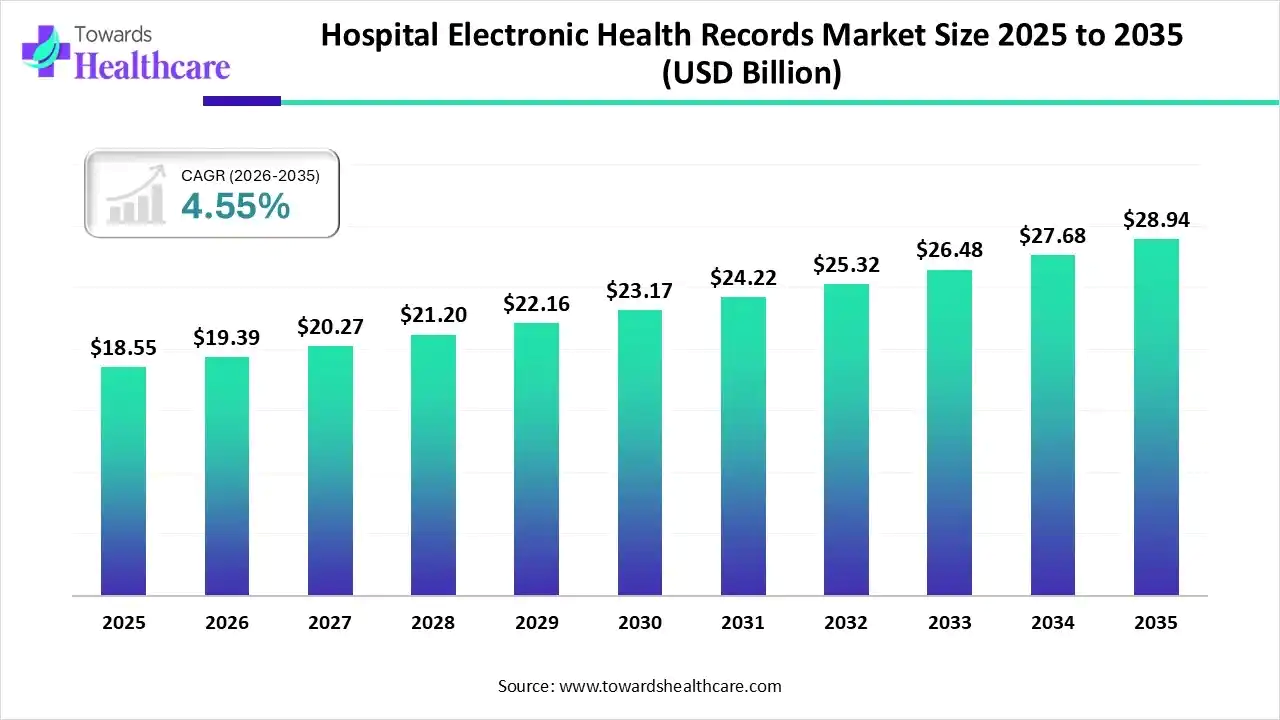
The global hospital electronic health records market size was valued at USD 18.55 billion in 2025 and is predicted to hit around USD 28.94 billion by 2035, rising at a 4.55% CAGR, a study published by Towards Healthcare a sister firm of Precedence Research.
Ottawa, Feb. 23, 2026 (GLOBE NEWSWIRE) -- The global hospital electronic health records market size is calculated at USD 19.39 billion in 2026 and is expected to reach around USD 28.94 billion by 2035, growing at a CAGR of 4.55% for the forecasted period.
Request a Personalized Sample that Speaks Directly to Your Business Needs | Download Now @ https://www.towardshealthcare.com/download-sample/6492
Key Takeaways
- North America accounted for the largest share of the hospital electronic health records market in 2025.
- Asia Pacific is expected to grow at the fastest CAGR in the studied years.
- By deployment, the cloud-based segment registered dominance in the market in 2025.
- By deployment, the web-based segment is expected to grow at a notable rate in the market during the forecast period.
- By type, the acute care segment led the market in 2025.
- By type, the post-acute segment is expected to grow at the fastest CAGR in the studied years.
- By business model, the professional services segment held the highest market share in 2025.
- By business model, the subscription segment is expected to grow at the highest CAGR in the market during the forecast period.
- By product, the integration segment accounted for a considerable revenue share in the market in 2025.
- By product, the standalone segment is expected to grow at the fastest CAGR in the studied years.
- By hospital size, the medium hospitals segment dominated the hospital electronic health records market in 2025.
- By hospital size, the large hospitals segment is expected to grow at the fastest CAGR in the studied years.
- By application, the cardiology hospitals segment led the market in 2025.
- By application, the ophthalmology segment is expected to grow at the fastest CAGR in the market during the studied years.
What are Hospital Electronic Health Records?
Hospital electronic health records (EHRs) are digital systems used by hospitals to securely store, manage, and share patient medical information, enabling coordinated care, accurate documentation, and efficient clinical decision-making. The hospital electronic health records market is growing due to increasing demand for digital patient data management, improved care coordination, and regulatory support for healthcare IT adoption. Hospitals are adopting EHR systems to enhance clinical efficiency, reduce medical errors, support data-driven decision-making, and integrate with telehealth, analytics, and interoperability solutions, improving overall healthcare quality and operational performance.
For Instance,
-
In October 2024, Oracle introduced an advanced EHR platform featuring intelligent clinical assistants, enhanced data search, and analytics-driven patient insights to improve healthcare operations. This development leverages Oracle’s USD 28.3 billion acquisition of Cerner and reflects its effort to strengthen care delivery while addressing earlier rollout and adoption challenges.
What are the Key Drivers in the Hospital Electronic Health Records Market?
Key drivers of the market include the growing need for centralized digital records, regulatory mandates supporting healthcare IT adoption, and demand for improved care coordination. Hospitals are leveraging EHR systems to reduce medical errors, enhance clinical workflows, enable data-driven decision-making, and support interoperability with telehealth, analytics, and population health management platforms, accelerating widespread implementation.
What are the Ongoing Trends in the Hospital Electronic Health Records Market?
- In January 2024, the U.S. Department of Health and Human Services emphasized ongoing policy updates aimed at simplifying patient access to medical records. These efforts build on actions announced in October 2023 to improve data transparency and strengthen patient control over personal health information.
- In January 2024, the Health Information Technology Advisory Committee provided support for policy refinement by the Office of the National Coordinator for Health Information Technology, emphasizing enhanced system interoperability, stronger safeguards for data privacy, and easier patient access to personal health information.
You can place an order or ask any questions, please feel free to contact us at sales@towardshealthcare.com
What is the Emerging Challenge in the Hospital Electronic Health Records Market?
An emerging challenge in the market is achieving true interoperability while maintaining strong data security. Hospitals often struggle with system integration across vendors, leading to fragmented data and workflow inefficiencies. At the same time, rising cybersecurity threats, clinician burnout from documentation burden, and high implementation and upgrade costs create barriers to adoption, optimization, and long-term system effectiveness.
Regional Analysis
What Made North America Dominant in the Hospital Electronic Health Records Market in 2025?
North America dominated the market in 2025 due to early adoption of healthcare IT< strong regulatory support, and widespread digital infrastructure. Government initiatives promoting interoperable health data, high hospital IT spending, and the presence of major EHR vendors accelerated implementation. Additionally, increasing focus on value-based care and data-driven clinical decision-making reinforced the region’s market leadership.
In the U.S., the hospital electronic health records market continues to expand as hospitals modernize clinical workflows and invest in digital systems for data management and interoperability. Federal incentives and broad adoption of cloud-based platforms are driving ongoing implementation across healthcare networks.
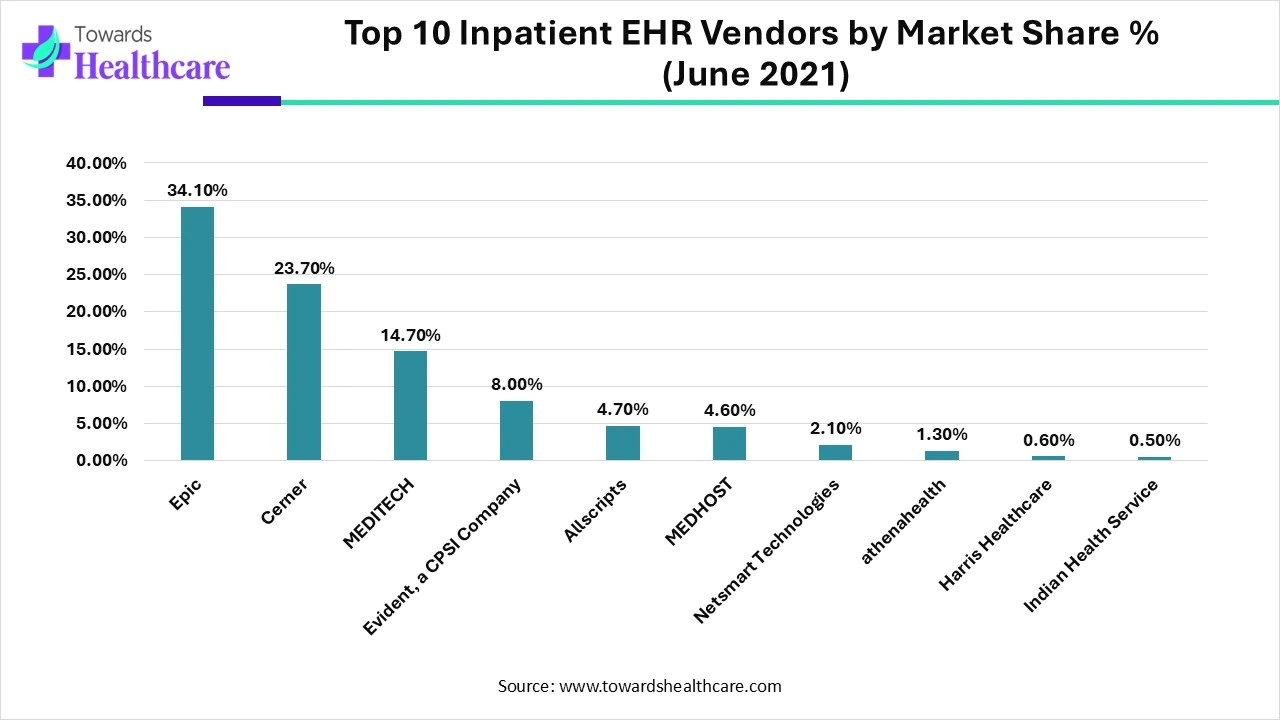
Competitive Positioning of U.S. Inpatient EHR Providers
Get the latest insights on life science industry segmentation with our Annual Membership: https://www.towardshealthcare.com/get-an-annual-membership
The inpatient EHR market is highly concentrated, with a few dominant vendors controlling the majority of hospital installations. Epic leads the segment with a significant margin, followed by Cerner and MEDITECH, collectively accounting for a substantial share of the market.
Mid-tier and niche vendors maintain smaller but strategically important footprints, particularly in community and specialized healthcare settings. The distribution reflects both consolidation trends and long-term enterprise adoption cycles within hospital systems.
How did the Asia Pacific Expand at the Fastest Pace in the Market in 2025?
Asia Pacific expanded at the fastest pace in the hospital electronic health records market in 2025 due to rapid healthcare digitization, increasing government investment, and rising adoption of cloud-based hospital systems. Growing patient volumes, expansion of private healthcare facilities, and national initiatives supporting health information exchange accelerated HER implementation. Improving internet infrastructure and demand for efficient clinical workflows further supported strong market growth across the region.
In China, hospital electronic health records are increasingly adopted alongside national healthcare IT initiatives, strengthening digital infrastructure. Large hospital networks and government support for smart hospital programs are accelerating EHR deployment, improving patient data access and operational efficiency in both urban and rural regions.
Segmental Insights
By Deployment Insights
How did the Cloud-based Segment Dominate the Hospital Electronic Health Records Market in 2025?
The cloud-based segment dominated the market in 2025 due to its scalability, lower upfront costs, and faster implementation compared to on-premise systems. Cloud platforms enable real-time data access, seamless updates, and improved interoperability across care settings. Hospitals increasingly preferred cloud solutions to support remote, disaster recovery, and integration with analytics and telehealth tools.
The web-based segment is expected to grow at a notable rate during the forecast period due to its ease of access, minimal infrastructure requirements, and compatibility with existing hospital systems. Web-based platforms allow clinicians to securely access patient records through standards browersers, supporting remote workflows and faster adoption. Growing demand for cost-effective, interoperable solutions and improved user experience further drives growth.
By Type Insights
Why the Acute Care Dominated the Hospital Electronic Health Records Market?
The acute care segment led the market in 2025 due to the high volume of hospital admissions requiring intensive, time-critical documentation. Acute care settings rely heavily on electronic health records to manage complex patient data, coordinate multidisciplinary care, reduce medical errors, and support rapid clinical decisions. Increasing emergency cases, chronic disease complications, and regulatory compliance requirements further strengthened HER adoption in acute care hospitals.
The post-acute segment is expected to grow at the fastest CAGR during the forecast period due to increasing demand for coordinated care after hospital discharge. Post-acute care providers are adopting electronic health records to improve care transitions, monitor patient recovery, reduce readmission, and support value-based reimbursement models. Rising elderly populations, chronic disease prevalence, and expansion of home health and rehabilitation services further accelerate adoption.
By Business Model Insights
How did the Professional Services Segment Dominate the Hospital Electronic Health Records Market in 2025?
The professional services segment held the highest market share in 2025 due to strong demand for EHR implementation, customization, systems integration, and staff training. Hospitals require expert support to align EHR Platforms with clinical workflows, regulatory requirements, and interoperability standards. Ongoing consulting and optimization services also help providers improve system performance, user adoption, and compliance, driving sustained reliance on professional service providers.
The subscription segment is expected to grow at the fastest CAGR during the forecast period due to its predictable pricing, lower upfront costs, and scalability. Hospitals increasingly prefer subscription-based EHR solutions for continuous software updates, cloud access, and vendor support. This model aligns well with budget constraints, supports faster deployment, and enables ongoing features enhancements without deployment, and enables ongoing features enhancements with large capital investments.
By Product Analysis
How did the Integration Segment Dominate the Hospital Electronic Health Records Market in 2025?
The integration segment dominated the market in 2025 due to the growing need to connect disparate clinical, administration, and diagnostic systems. Hospitals invest heavily in solutions to enable seamless data exchange, improve interoperability, and support coordinated care across departments. Integration tools also helped organizations comply with regulatory standards and enhanced workflow efficiency, strengthening their leading market position.
The standalone segment is expected to grow at the fastest CAGR during the forecast period due to rising demand from small and mid-sized hospitals seeking cost-effective EHR solutions. Standalone systems offer faster deployment, simplifies functionality, and lower maintenance requirements. These solutions are increasingly adopted in facilities with limited IT infrastructure, enabling digital records management without complex system integration.
By Hospital Size Insights
Why the Medium Hospitals Dominated the Hospital Electronic Health Records Market?
The medium hospitals segment dominated the market due to their strong need for digital transformation, balanced with manageable implementation complexity. These hospitals handle substantial patient volume while maintaining limited administrative resources, making EHR systems essential for efficiency, compliance, and care coordination. Compared to small facilities, they have higher IT budgets, and unlike large hospitals, they face fewer customization challenges, driving faster and broader adoption.
The large hospitals segment is expected to grow at the fastest CAGR during the forecast period due to increasing patient volumes, complex care delivery, and rising demand for advanced digital infrastructure. Large hospitals are investing in scalable EHR platforms to support interoperability, analytics, and value-based care initiatives. Ongoing upgrades, systems expansion, and integration with emerging technologies further accelerate adoption in this segment.
By Application Insights
How did the Cardiology Hospitals Segment Dominate the Hospital Electronic Health Records Market in 2025?
The cardiology hospitals segment dominated the market in 2025 due to the high volume of complex patient data generated from cardiac diagnostics, imaging, and continuous monitoring. These facilities rely on long-term patient histories and support timely clinical decisions. Rising cardiovascular disease prevalence and demand for coordinated, data-driven cardiac care further reinforced strong EHR adoption.
The ophthalmology segment is expected to grow at the fastest CAGR during the forecast period due to the rising prevalence of vision disorders and increasing demand for specialized eye care. Ophthalmology practices are adopting electronic health records to manage image-intensive data, streamline high patient volumes, and support precise diagnostics, interventions, procedures, and workflow automation, further accelerating HER implementation in this segment.
Become a valued research partner with us - https://www.towardshealthcare.com/schedule-meeting
What are the Recent Developments in the Hospital Electronic Health Records Market
- In May 2025, students at Northeastern University created a digital solution designed to minimize disruptions caused by EHR system outages. The tool, Samantha, enables hospitals to securely retrieve essential patient information during downtime, supporting faster appointment coordination and informed clinical decisions, ultimately helping maintain continuity of care when primary systems are unavailable.
- In March 2025, InterSystems introduced its advanced EHR platform, IntelliCare, during HIMSS 2025. The system emphasizes built-in intelligence and interoperability, offering features such as ambient voice capture, automated clinical documentation, voice-based commands, and smooth integration with existing hospital IT environments to improve workflow efficiency and care delivery.
Key Players List
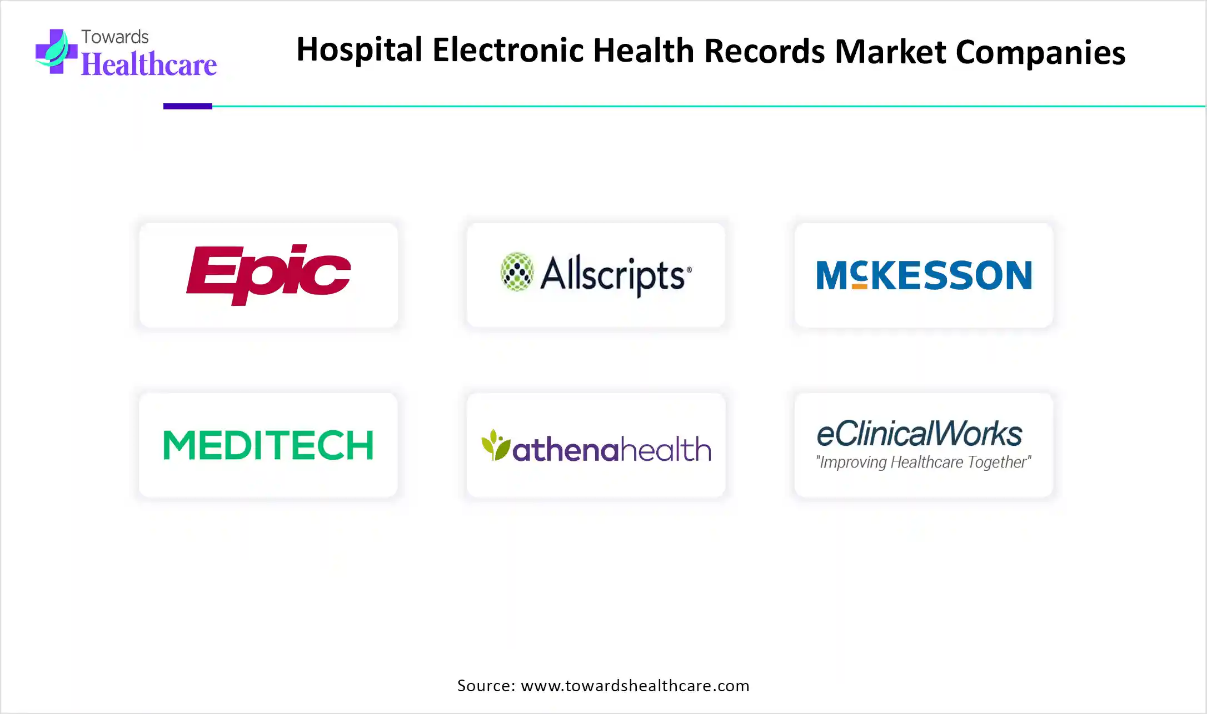
- Epic Systems Corporation
- Oracle
- Evident (CPSI Company)
- Altera Digital Health Inc.
- MEDHOST
- WellSky
- Vista
- Netsmart Technologies, Inc.
- Medical Information Technology, Inc.
- Veradigm LLC
Browse More Insights of Towards Healthcare:
The global electronic health records market size is calculated at USD 29.84 billion in 2025 and is expected to be worth USD 45.55 billion by 2035, expanding at a CAGR of 4.32% from 2026 to 2035.
The global electronic batch records market size is calculated at US$ 1.17 in 2024, grew to US$ 1.34 billion in 2025, and is projected to reach around US$ 4.51 billion by 2034. The market is expanding at a CAGR of 14.44% between 2025 and 2034.
The global healthcare ERP market size is calculated at USD 8.57 billion in 2025, grew to USD 9.19 billion in 2026, and is projected to reach around USD 17.22 billion by 2035. The market is expanding at a CAGR of 7.23% between 2026 and 2035.
The global pharmaceutical electronic distribution market size was estimated at USD 70.27 billion in 2025 and is predicted to increase from USD 76.27 billion in 2026 to approximately USD 159.46 billion by 2035, expanding at a CAGR of 8.54% from 2026 to 2035.
The global hospital services market size was calculated at USD 12.08 trillion in 2025, to reach USD 13.19 trillion in 2026 is expected to be worth USD 28.99 trillion by 2035, expanding at a CAGR of 9.15% from 2026 to 2035. The rising prevalence of chronic disorders, technological advancements, and increasing investments drive the market.
The global hospital temperature monitoring system market size was estimated at USD 1.37 billion in 2025 and is predicted to increase from USD 1.48 billion in 2026 to approximately USD 2.91 billion by 2035, expanding at a CAGR of 7.84% from 2026 to 2035.
The global electronic lab notebook market size is calculated at USD 750.82 million in 2025, grew to USD 805.33 million in 2026, and is projected to reach around USD 1513.26 million by 2035. The market is expanding at a CAGR of 7.26% between 2026 and 2035.
The global hospital HVAC systems market size is calculated at USD 11.03 billion in 2024, grows to USD 11.83 billion in 2025, and is projected to reach around USD 22.19 billion by 2034. The market is expanding at a CAGR of 7.24% between 2025 and 2034.
The global disposable hospital supplies market size is calculated at US$ 26.69 in 2024, grew to US$ 29.08 billion in 2025, and is projected to reach around US$ 62.5 billion by 2034. The market is expanding at a CAGR of 9.01% between 2025 and 2034.
The healthcare digital twin market size is predicted to expand from USD 3.26 billion in 2025 to USD 77.4 billion by 2034, growing at a CAGR of 42.2% during the forecast period from 2025 to 2034.
Segments Covered in the Report
By Deployment
- On-premise
- Web-Based
- Cloud-Based
By Type
- Acute
- Outpatient
- Post Acute
By Business Model
- Licensed Software
- Technology Resale
- Subscriptions
- Professional Services
- Others
By Product
- Standalone
- Integrated
By Hospital
- Large Hospital
- Medium Hospital
- Small Hospital
By Application
- Cardiology
- Neurology
- Radiology
- Oncology
- Mental and Behavioral Health
- Nephrology and Urology
- Gastroenterology
- Pediatrics
- General Medicine
- Physical Therapy and Rehabilitation
- Others
By Region
- North America
- U.S.
- Canada
- Europe
- UK
- Germany
- France
- Italy
- Spain
- Denmark
- Sweden
- Norway
- Asia Pacific
- Japan
- China
- India
- South Korea
- Australia
- Thailand
- Latin America
- Brazil
- Mexico
- Argentina
- Middle East & Africa
- South Africa
- Saudi Arabia
- UAE
- Kuwait
Invest in this Premium Research Report for Smarter Decisions | Buy Now @ https://www.towardshealthcare.com/checkout/6492
Access our exclusive, data-rich dashboard dedicated to the healthcare market - built specifically for decision-makers, strategists, and industry leaders. The dashboard features comprehensive statistical data, segment-wise market breakdowns, regional performance shares, detailed company profiles, annual updates, and much more. From market sizing to competitive intelligence, this powerful tool is one-stop solution to your gateway.
Access the Dashboard: https://www.towardshealthcare.com/access-dashboard
About Us
Towards Healthcare is a leading global provider of technological solutions, clinical research services, and advanced analytics, with a strong emphasis on life science research. Dedicated to advancing innovation in the life sciences sector, we build strategic partnerships that generate actionable insights and transformative breakthroughs. As a global strategy consulting firm, we empower life science leaders to gain a competitive edge, drive research excellence, and accelerate sustainable growth.
You can place an order or ask any questions, please feel free to contact us at sales@towardshealthcare.com
Europe Region: +44 778 256 0738
North America Region: +1 8044 4193 44
APAC Region: +91 9356 9282 04
Web: https://www.towardshealthcare.com
Our Trusted Data Partners
Precedence Research | Towards Packaging | Towards Food and Beverages | Towards Chemical and Materials | Towards Dental | Towards EV Solutions | Healthcare Webwire
Find us on social platforms: LinkedIn | Twitter | Instagram | Medium | Pinterest
Also Read:
https://www.towardshealthcare.com/insights/healthcare-consumables-market-sizing
https://www.towardshealthcare.com/insights/rtls-in-healthcare-market-sizing
https://www.towardshealthcare.com/insights/smart-hospitals-market-sizing
https://www.towardshealthcare.com/insights/rehabilitation-equipment-market-sizing
https://www.towardshealthcare.com/insights/flexible-endoscopes-market-sizing
https://www.towardshealthcare.com/insights/ai-in-lab-automation-market-sizing
https://www.towardshealthcare.com/insights/oncology-clinical-trial-monitor-market-sizing
https://www.towardshealthcare.com/insights/healthcare-cloud-computing-market-sizing
https://www.towardshealthcare.com/insights/computer-vision-in-healthcare-market-sizing
https://www.towardshealthcare.com/insights/metaverse-in-healthcare-market-size
https://www.towardshealthcare.com/insights/laboratory-information-management-systems-market-sizing


Legal Disclaimer:
EIN Presswire provides this news content "as is" without warranty of any kind. We do not accept any responsibility or liability for the accuracy, content, images, videos, licenses, completeness, legality, or reliability of the information contained in this article. If you have any complaints or copyright issues related to this article, kindly contact the author above.
