

Smart Conveyor System Market to Reach US$ 9.3 Billion by 2036, Growing at 11.2% CAGR on Rising Automation | TMR
Smart Conveyor System Market
Global market to grow at 11.2% CAGR from 2026–2036, driven by automation adoption and e-commerce fulfilment demand.
Smart conveyors are evolving into intelligent logistics backbones, enabling predictive maintenance, robotic integration, and real-time optimization across modern factories”
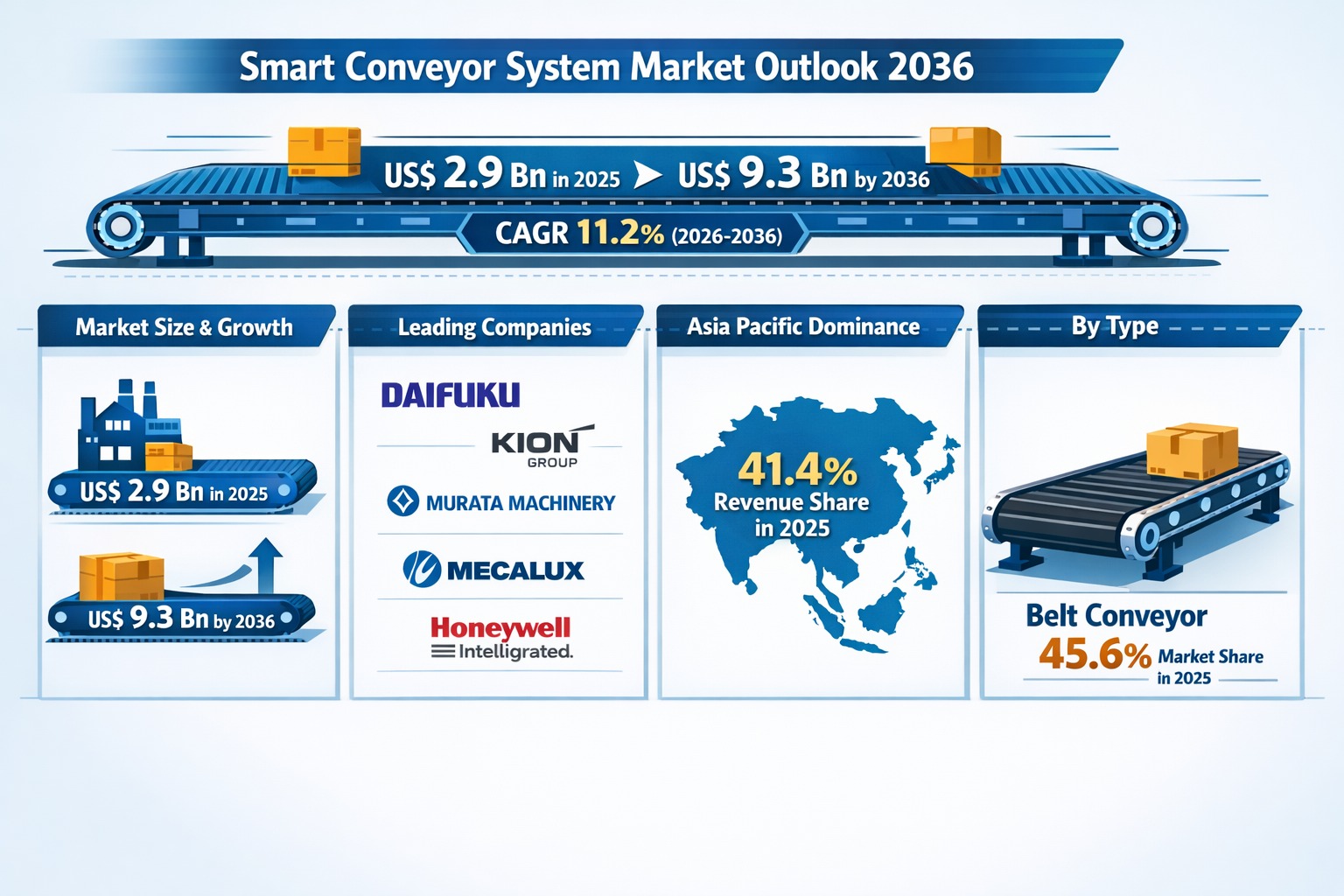
WILMINGTON, DE, UNITED STATES, February 17, 2026 /EINPresswire.com/ -- The global smart conveyor system market was valued at US$ 2.9 Bn in 2025 and is projected to reach US$ 9.3 Bn by 2036, expanding at a robust CAGR of 11.2% from 2026 to 2036. This impressive growth trajectory reflects the accelerating adoption of automation technologies across manufacturing, warehousing, and logistics ecosystems worldwide.— Transparency Market Research
Historically, the market demonstrated steady expansion between 2021 and 2024, supported by the rise in warehouse modernization and industrial robotics. Moving forward, smart conveyors are transitioning from being simple material-transport mechanisms to becoming integral nodes within enterprise resource planning (ERP), warehouse management systems (WMS), and autonomous production environments.
By revenue, the industry is expected to more than triple over the forecast period, highlighting strong capital inflows and infrastructure modernization efforts across both developed and emerging economies.
→Discover Market Opportunities - Request Your Sample Copy Now: https://www.transparencymarketresearch.com/sample/sample.php?flag=S&rep_id=86935
Market Overview
Smart conveyor systems are advanced material-handling solutions equipped with embedded sensors, IoT connectivity, data analytics platforms, and intelligent control software. Unlike traditional conveyors, these systems can self-monitor, communicate performance metrics in real time, detect anomalies, and adapt throughput based on demand fluctuations.
They serve as the backbone of high-volume industrial and logistics operations—ranging from automotive manufacturing plants and electronics facilities to e-commerce fulfilment centers and airport baggage handling systems.
The transformation of global supply chains, increasing need for just-in-time (JIT) manufacturing, and rapid order fulfilment expectations have made intelligent conveyor systems indispensable. Organizations are no longer investing in conveyors merely for movement of goods, but for predictive insights, operational transparency, and integrated automation capabilities.
Key Market Growth Drivers
Rising Industrial Automation Adoption
The rapid global shift toward automation is a primary catalyst for smart conveyor system demand. Modern factories now integrate robotics, machine vision, AI-driven quality inspection, and digital twins—all of which require intelligent material flow systems.
According to the International Federation of Robotics (IFR), the total number of industrial robots operating worldwide reached 4,281,585 units in 2023, signaling an unprecedented automation base. Smart conveyor systems complement these robots by synchronizing material movement, optimizing robotic picking cycles, and reducing idle time.
These conveyors also enable predictive maintenance through sensor-driven diagnostics. By detecting belt tension irregularities, motor wear, or vibration anomalies, operators can significantly reduce unplanned downtime and labor costs.
Growing Need for E-commerce Fulfilment
The exponential growth of global e-commerce is reshaping logistics infrastructure. Same-day and next-day delivery models demand highly automated, error-free sorting and packaging processes.
Smart conveyors equipped with edge analytics and adaptive routing capabilities can dynamically redirect parcels, detect congestion, and maintain optimal throughput levels. This capability is essential in large fulfilment centers processing thousands of SKUs daily.
Integration with automated storage and retrieval systems (AS/RS) and warehouse management platforms further enhances operational efficiency. As digital retail penetration continues to rise, smart conveyors are becoming foundational to scalable and flexible fulfilment networks.
Market Challenges & Opportunities
Key Challenges
Despite strong growth prospects, the market faces several constraints:
High Initial Capital Investment: Smart conveyor installations require substantial upfront costs, especially in retrofitting legacy systems.
Complex Integration Requirements: Interoperability between conveyors, robots, ERP systems, and IoT platforms demands technical expertise.
Cybersecurity Risks: Increased connectivity exposes systems to potential digital vulnerabilities.
Major Opportunity: AI-Driven Predictive and Prescriptive Analytics
A major opportunity lies in deeper integration of Artificial Intelligence (AI) and Machine Learning (ML). While current systems monitor performance, next-generation smart conveyors will perform prescriptive analytics—recommending corrective actions before disruptions occur.
AI-driven route optimization can dynamically adjust material flow across large facilities based on demand forecasting models. The MHI Annual Industry Report indicates that 85% of industry respondents believe AI-powered inventory and network optimization tools will offer competitive advantage.
This transition toward intelligent, self-optimizing logistics ecosystems represents a significant revenue opportunity for technology providers.
→Explore Strategies & Trends - Request Full Report Access – https://www.transparencymarketresearch.com/sample/sample.php?flag=S&rep_id=86935
Segment Outlook
By Type
The Belt Conveyor segment dominated the market with a 45.6% share in 2025. Belt conveyors are preferred due to their versatility, reliability, and ability to handle diverse load sizes and weights.
They are widely used in logistics centers, manufacturing plants, and food processing units. Their compatibility with IoT sensors and real-time monitoring systems ensures continued dominance over the forecast period.
Other segments include roller conveyors, overhead conveyors, chain conveyors, screw conveyors, bucket conveyors, and slat conveyors.
By Technology
Sensor-Enabled Smart Conveyors
Connected / IoT-Integrated Conveyors
Adaptive Smart Conveyors
Autonomous Conveyor Systems
Connected and IoT-integrated conveyors are witnessing strong traction due to the need for centralized monitoring and remote diagnostics.
By Capacity Type
Unit Handling
Bulk Handling
Unit handling systems dominate due to e-commerce and parcel logistics growth.
By End-Use
Key sectors include:
E-commerce & Fulfilment Centers
Logistics and Warehousing
Retail
Automotive
Electronics & Semiconductor
Food & Beverage
Airports & Cargo
Pharmaceutical & Healthcare
Mining and Others
E-commerce and logistics remain the fastest-growing segments.
Regional Outlook
Asia Pacific – Leading Region
Asia Pacific held the largest revenue share of 41.4% in 2025. Rapid industrialization, strong electronics and automotive manufacturing bases, and expanding logistics infrastructure are driving growth.
Countries such as China, Japan, India, South Korea, and ASEAN economies are heavily investing in automation technologies. High industrial robot density in the region further supports smart conveyor adoption.
North America
The U.S. and Canada are key markets driven by warehouse automation and advanced robotics integration.
Europe
Germany, the U.K., France, Italy, Spain, and the Netherlands lead adoption, particularly in automotive and airport logistics sectors.
Middle East & Africa and Latin America
Growing industrial diversification and infrastructure investments in GCC countries, Brazil, Mexico, and Argentina are expected to create moderate growth opportunities.
Analysis of Key Players – Key Player Strategies
Leading companies in the smart conveyor system market include:
BEUMER Group, Daifuku Co., Ltd., Dorner Conveyors, Fives, FlexLink (Coesia), Honeywell Intelligrated, Hytrol Conveyor Company, Interroll Group, KION Group, Mecalux, S.A., Murata Machinery Ltd., SSI Schaefer, Swisslog, TGW Logistics Group, Vanderlande Industries, and other key players.
Key Player Strategies
Strategic Acquisitions to expand technological capabilities
AI and IoT Integration for intelligent product portfolios
Geographic Expansion in Asia Pacific and emerging economies
Customized Automation Solutions tailored to sector-specific needs
Partnerships with Robotics and Software Firms
These companies focus on enhancing system intelligence, scalability, and lifecycle service offerings.
Recent Developments
In July 2025, Siemens AG took over ebm-papst’s industrial drive technology business, thereby enhancing its range of industrial automation components that are supporting smart conveyor drives and system integration, which again leads to the wider acceptance of automation in material handling.
In July 2025, Honeywell proclaimed that it started looking at the WWS (Warehouse and Workflow Solutions) business that includes the Intelligrated conveyor systems, as part of the larger portfolio optimization. The company is trying to clear up its areas of focus in automation, and that might involve either splitting up or selling the unit which will, in turn, have a major influence on the competitive arena of the North American material handling market.
In May 2025, Vanderlande successfully finalized the acquisition of the Siemens Logistics business in Europe, Asia, and the Middle East, which is a deal that was first proclaimed in late 2024. This merging of the two companies opens up new territories for Vanderlande in the sectors of airport logistics and baggage handling, and at the same time the company is able to offer Siemens' conveyor and sorting technologies in its global portfolio thus increasing the operational scale and service capability.
In April 2025, FLSmidth (FLS) announced that a mine in Africa would be among the first to use its next-generation rail-running conveyor (RRC) technology. This very deployment, which has been produced in collaboration with the University of Newcastle, is a great step forward in heavy-duty material handling as it can handle high-capacity loads in tough conditions and reduce energy consumption and operating costs in the mining industry.
Investment Landscape and ROI Outlook
The smart conveyor system market presents strong investment potential due to:
Double-digit CAGR of 11.2%
Expansion of automation infrastructure
Growing robotics installations
E-commerce warehouse construction boom
Capital investments in smart material-handling infrastructure typically generate ROI through:
Reduced downtime
Lower labor dependency
Increased throughput efficiency
Energy savings
Improved order accuracy
Long-term ROI is particularly attractive in high-volume logistics and manufacturing facilities where even marginal efficiency gains translate into millions of dollars in operational savings annually.
Why Buy This Report?
Comprehensive market size and 2036 forecast analysis
In-depth qualitative and quantitative insights
Competitive landscape and revenue share analysis (2025)
Detailed segmentation across type, technology, capacity, and end-use
Regional analysis covering 20+ countries
Strategic profiling of leading market players
Porter’s Five Forces, SWOT, and value chain analysis
Delivered in Electronic (PDF) + Excel format
This report enables stakeholders to make informed strategic decisions, evaluate expansion opportunities, and understand competitive positioning.
FAQs
Q.How big was the global smart conveyor system market in 2025?
A.The global smart conveyor system market was valued at US$ 2.9 Bn in 2025.
Q.How large will the market be by 2036?
A.It is projected to reach US$ 9.3 Bn by the end of 2036.
Q.What is driving market growth?
A.Rising industrial automation adoption and growing need for e-commerce fulfilment are key growth drivers.
Q.What is the expected CAGR during 2026–2036?
A.The market is anticipated to expand at a CAGR of 11.2%.
Q.Who are the prominent players in the global smart conveyor system market?
A.Major players include BEUMER Group, Daifuku Co., Ltd., Dorner Conveyors, Fives, FlexLink (Coesia), Honeywell Intelligrated, Hytrol Conveyor Company, Interroll Group, KION Group, Mecalux, S.A., Murata Machinery Ltd., SSI Schaefer, Swisslog, TGW Logistics Group, Vanderlande Industries, and others.
Buy Full Report Now: https://www.transparencymarketresearch.com/checkout.php?rep_id=86935<ype=S
→Explore Latest Research Reports by Transparency Market Research:
Overhead Cranes Market: https://www.transparencymarketresearch.com/overhead-cranes-market.html
Clinching Machine Market: https://www.transparencymarketresearch.com/north-america-and-europe-clinching-machine-market.html
Stacking Cranes Market: https://www.transparencymarketresearch.com/stacking-cranes-market.html
Slotting Machine Market: https://www.transparencymarketresearch.com/slotting-machine-market.html
Sectional Warping Machine Market: https://www.transparencymarketresearch.com/sectional-warping-machine-market.html
About Transparency Market Research
Transparency Market Research, a global market research company registered at Wilmington, Delaware, United States, provides custom research and consulting services. Our exclusive blend of quantitative forecasting and trends analysis provides forward-looking insights for thousands of decision makers. Our experienced team of Analysts, Researchers, and Consultants use proprietary data sources and various tools & techniques to gather and analyses information.
Our data repository is continuously updated and revised by a team of research experts, so that it always reflects the latest trends and information. With a broad research and analysis capability, Transparency Market Research employs rigorous primary and secondary research techniques in developing distinctive data sets and research material for business reports.
Abhishek Budholiya - Marketing Team
Transparency Market Research Inc.
+1 518-618-1030
email us here
Legal Disclaimer:
EIN Presswire provides this news content "as is" without warranty of any kind. We do not accept any responsibility or liability for the accuracy, content, images, videos, licenses, completeness, legality, or reliability of the information contained in this article. If you have any complaints or copyright issues related to this article, kindly contact the author above.
